


MAHARṢI AGASTYA
Sage, Civilizational Integrator, Scientist-Ṛṣi
Agastya is one of the most revered sages of the Vedic tradition and is counted among the Saptarṣis in several lineages.
Birth & Lineage
Father: Sage Pulastya (one of Brahmā’s mind-born sons)
Mother: Born from a kumbha (pot) — symbolizing non-biological, tapas-born origin
Wife: Lopāmudrā (herself a Rigvedic ṛṣikā)
Son: Dṛḍhasyu
📌 The “pot-born” motif symbolises knowledge born from tapas, not genealogy.
Maharṣi Agastya: Sage, Scientist, and Civilizational Bridge of India
Introduction (5 minutes)
Good morning/afternoon everyone.
Today’s lecture is on Maharṣi Agastya, one of the most remarkable figures in Indian intellectual and civilizational history. Unlike many sages who are associated with a single region or discipline, Agastya represents integration—of geography, culture, science, spirituality, and language.
He is:
A Vedic seer
A founder figure of South Indian civilization
A scientist–sage in medicine, metallurgy, and chemistry
A linguist and grammarian
A cultural unifier between North and South India
Understanding Agastya is essential to understanding how Indian civilization became pan-Indian rather than regionally fragmented.
1. Historical & Textual Background (10 minutes)
Chronology
Agastya belongs to the early Vedic period, traditionally dated between 1500–1000 BCE
He is mentioned in:
Rigveda
Ramayana
Mahabharata
Puranas
Tamil Sangam literature
Siddha medical texts
Important academic note:
Agastya should not be seen as a single historical individual alone, but as a civilizational archetype, possibly representing a lineage or school of knowledge.
2. Agastya in the Rigveda: A Vedic Seer (10 minutes)
Agastya is one of the few sages to whom entire hymns of the Rigveda are attributed.
Key Contributions
Mandala 1 (Hymns 165–191) are associated with Agastya
He is credited with hymns to:
Indra
Varuna
Mitra
Intellectual Significance
His hymns emphasize:
Cosmic order (Ṛta)
Harmony between natural forces
Ethical restraint in power
Agastya’s Rigvedic identity firmly places him in early Vedic philosophical tradition, not as a later mythical insertion.
3. The Southern Migration & Cultural Integration (10 minutes)
One of Agastya’s most important roles is as a civilizational bridge.
The Vindhya Legend
According to tradition, the Vindhya mountains grew arrogantly and blocked the sun.
Agastya asked them to bow—and they remained lowered until his return.
Symbolically, this represents:
Removal of geographical and cultural barriers
Opening the path to the South
Historical Meaning
Agastya is credited with:
Bringing Vedic culture to South India
Establishing āśramas in the Deccan and Tamil regions
Integrating local traditions with Vedic philosophy
This is why Agastya is revered equally in North and South India, unlike most sages.
4. Agastya and Tamil Civilization (10 minutes)
Agastya holds an extraordinary position in Tamil tradition.
Father of Tamil Grammar
He is traditionally credited with Agattiyam, an early Tamil grammatical treatise (now lost)
Tamil Sangam literature refers to him as:
“Tamil munivar” – the sage of Tamil
Sangam Tradition
Agastya is said to have presided over the First Tamil Sangam
He legitimized Tamil as a classical, sacred language, not inferior to Sanskrit
This makes Agastya one of the earliest proponents of linguistic pluralism in India.
5. Agastya as Scientist & Siddha Tradition (15 minutes)
This is where Agastya becomes especially relevant to modern interdisciplinary studies.
Siddha Medicine
Agastya is considered the founder of Siddha medical system, especially in Tamil regions.
Areas Covered:
Herbal medicine
Mineral and metal-based medicines
Toxicology
Longevity and rejuvenation (kāya-kalpa)
Chemistry & Metallurgy
Texts attributed to Agastya include:
Agastya Saṁhitā
Agastya Rasāyana
Lohasāstra works
These discuss:
Mercury purification
Sulphur compounds
Alloys
Medicinal metals
The “Agastya Battery” (Academic Caution)
Some verses describe electrochemical processes
While modern claims of ancient batteries should be treated cautiously, they indicate:
Advanced experimental thinking
Proto-chemical knowledge
6. Agastya in Epics: Ethical & Spiritual Guide (10 minutes)
In the Ramayana
Agastya receives Rama in the forest
He gifts Rama divine weapons
He advises Rama on kingship, restraint, and duty
In the Mahabharata
Agastya represents:
Ascetic power
Moral authority
Balance between tapas and responsibility
Agastya is never portrayed as power-hungry—he is the ideal sage-statesman.
7. Philosophical Worldview of Agastya (10 minutes)
Agastya’s philosophy is practical spirituality.
Key principles:
Knowledge must serve society
Spirituality must coexist with science
Nature is to be understood, not conquered
Language and culture are sacred carriers of wisdom
Unlike renunciatory extremes, Agastya advocates:
Engaged asceticism
8. Relevance in the Modern World (5 minutes)
Agastya is relevant today because he represents:
Interdisciplinary knowledge
Cultural unity in diversity
Scientific inquiry without materialism
Respect for regional languages
Sustainable living
He challenges the false divide between:
Science vs spirituality
North vs South
Tradition vs innovation
Conclusion (5 minutes)
To conclude:
Maharṣi Agastya is not merely a sage of the past—he is a template for civilizational wisdom.
He teaches us that:
Knowledge travels
Cultures integrate
Science and spirituality can coexist
Unity does not require uniformity
In many ways, Agastya is the silent architect of Indian civilization.
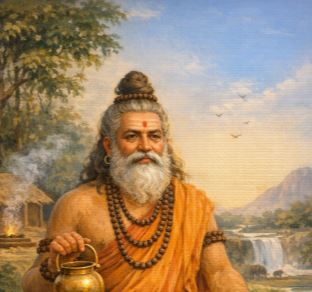
MAHARṢI AGASTYA
Proffession: Scientist
Nationality: Indian